
W17 Sailing Trimaran


For more descriptive information on the W17, CLICK on one of the links below…
Review of W17 Hull Forms
Intro Part 1—The W17 Design
Intro Part 2—Building the W17
Intro Part 3—Build Manual & Plans
W17R—Racing Rig
Further Information…
LATEST NEWS on Building the W17
Sailing Pics and Reports of the W17
CNC-cut Plywood Kit for the W17 (February 18, 2011)
Study Profile of the W17 Sailing Trimaran
Many sailors are intrigued or already bitten by the multihull bug, but not everyone is ready to put thousands of hours into building, or dollars into buying boats now on the market. So for those seeking to experience the pleasures of sailing flat and fast, getting on a beach cat has commonly been the way to go. But though exciting, they do tend to be very wet, have almost no storage, are often uncomfortable and come with a tendency to flip with little warning.Today, from racing around the globe to the prestigious America's Cup, winning boats are commonly TRIMARANS, so a small trimaran is clearly an attractive alternative way-to-go and the W17 has been designed not only for home construction at relatively low cost, but also to improve significantly on the attributes of a beach cat without many of the disadvantages.
With all my designs, I am personally looking for 'Overall Performance' and by that I mean a blend of attributes that makes my boats a real pleasure to own and sail. First of all, I want them to feel and perform efficiently. I also want them cost effective, comfortable and drier than their competitors and to provide a sailing satisfaction that brings the lucky owners home with undeniable smiles on their faces—and we now know that the W17 is such a boat.
This boat readily folds to only 7'-3" (2.2 m)—less than most day catamarans and can be trailed on a flat-bed trailer or sat on the sand. She is stable and roomy yet still moves with the ease and fine feel of a thoroughbred. She is designed with a rotating wingmast in mind; one that can be homebuilt with plans available via this website, for either a wood-glass wingmast for the cruise rig or for a fine carbon-fiber wingmast for the Race rig that has received enthusiastic reviews of its own. And I'd wager that the W17 Plans and Build Manual are more detailed than any previous 17-footer out there on the market! So take a read through the other articles in the W17 Main Page and take a serious thought about giving a small trimaran a try. There is something extremely satisfying about building your own boat as many in the past have learned. But there are not many designs out there that still use familiar material like plywood (that's available almost the world over), yet still retain a professional look to the design, rig and physical boat. Its combination with epoxy and glass using the unique ABC System, makes for easy maintenance that goes a long way to prolonging its life when used as directed. With space for 3-4 to daysail or by enjoying some fast sailing for 1-2, this boat will change the way you think about sailing. With her dryness, high stability, self-draining cockpit and great upwind performance in a wide range of conditions, she makes a super camp-cruiser. And for anyone who thinks the hull shapes are too basic or unsophisticated, I urge you to read the tech. articles about these shapes and the sailors reviews. I guarantee you will have zero sensation of 'sailing on a box' when you sail a W17. The smooth, quiet efficiency is a shock to many.
Enjoy!
Only the CRUISING RIG shown here
|
Basic DESIGN DATA:
|
| Designed by: | mike waters n.a. | |
| LOA: | 5.20 m (17'-1") | |
| LWL: | 5.14 m (16'-10") | |
| Beam sailing: | 4.25 m (13'-11") | |
| Beam folded: | 2.2 m (7'-3") | |
| SAIL AREA: | ||
| Main: | 11.1 m² (120 ft²) | |
| Jib: | 4.4 m² (47 ft²) | |
| Total upwind: | 15.5 m² (167 ft²) | |
| Wing Mast: | 7.35 m (24 ft) | |
Wing Mast adds 10 ft² to shown Cruising Rig. Optional Racing Rig has 200 ft² |
||
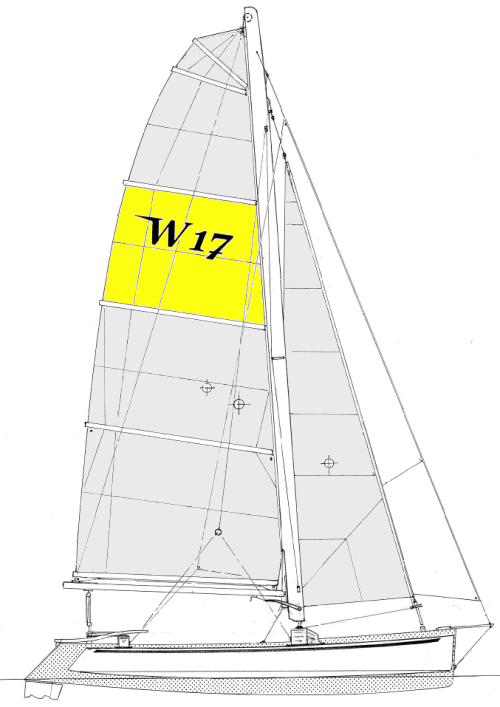

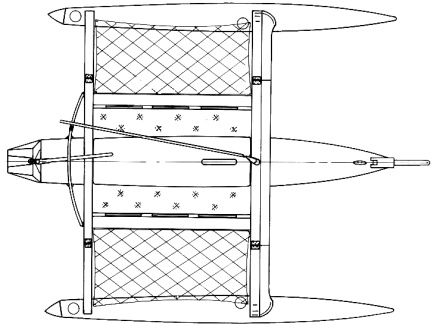
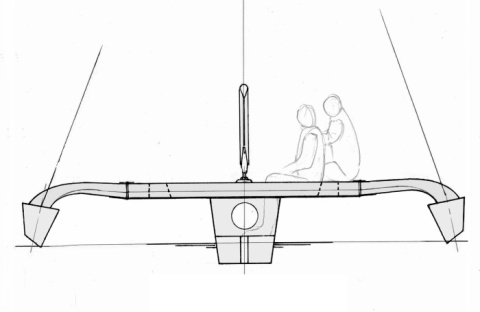

| LIST of PRINCIPAL MATERIALS | ||
| Description | Quantity (main items only) | |
| Plywood 4' x 8' (1.22 m x 2.44 m) x 4.5 mm | 9 sheets | |
| Plywood 4' x 8' (1.22 m x 2.44 m) x 6 mm | 7 sheets | |
| Plywood 4' x 8' (1.22 m x 2.44 m) x 3 mm | 1.25 sheets | |
| Spruce/Pine/Cedar (stringers) | 30 bd-ft (2.5 ft³, 0.07 m³) | |
| Hardwood - mahogany | 6 bd-ft (0.5 ft³, 0.01 m³) | |
| Epoxy resin & hardener, fillers | 4–6 gallons - depending on sheathing | |
| Fibreglass cloth (6-oz) | 50–80 sq-yd - depending on sheathing | |
| Fibreglass - 45/45 Bias and Unidirectional cloth | small quantities | |
| Paint - Varnish to finish | ||
| LIST of PLANS |
|
W17 - 01 SailPlan Cruise + 01R Sailplan for Race Rig Detailed Build Manual is over 100 pages with 100+ photos and sketches |


"If you have any questions about the W17, please use our question & comments form." —webmaster
"See the Copyright Information & Legal Disclaimer page for copyright info and use of ANY part of this text or article"